Story as Counterweight
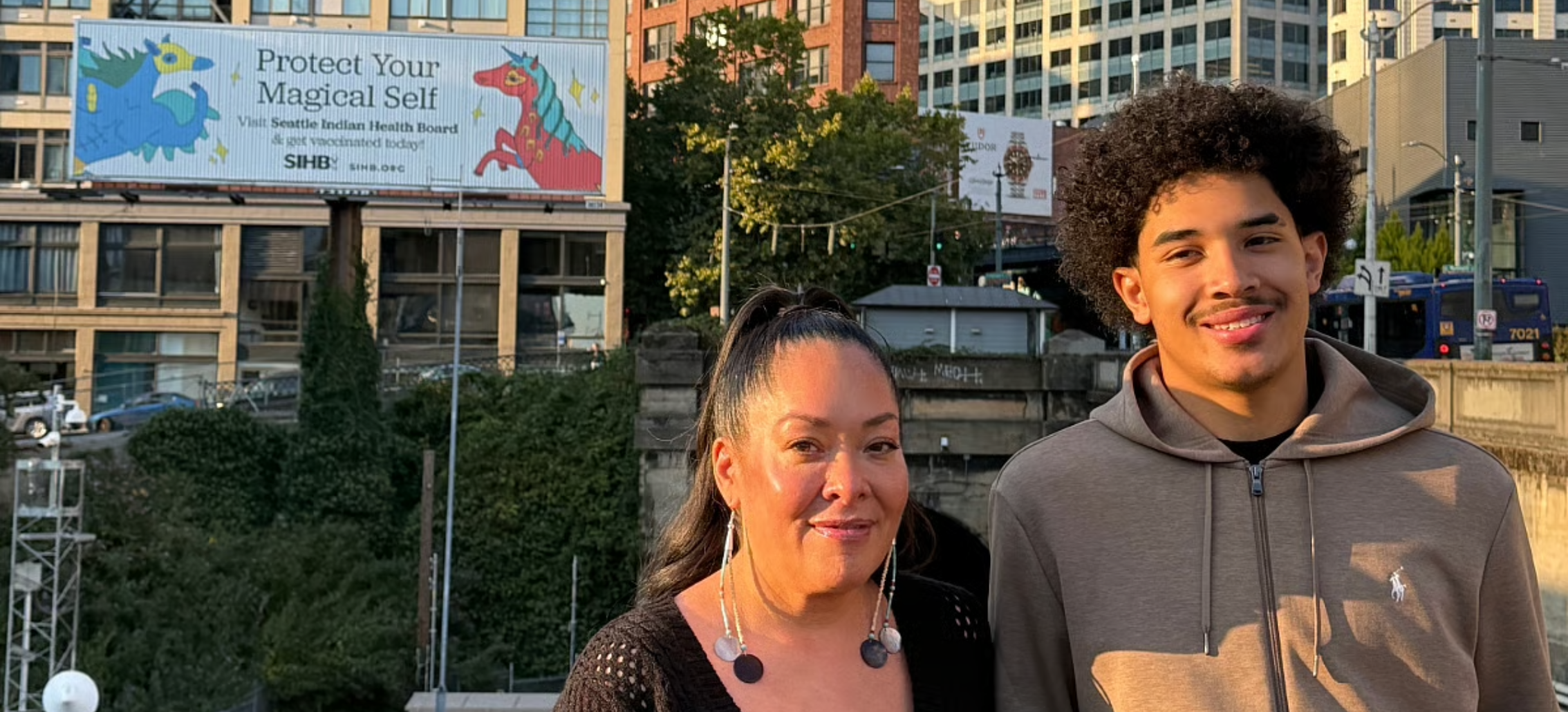
Abigail Echo-Hawk and G'Centae Rodriguez stand in front of a billboard on Yesler Way for "Magical Millie’s Courageous Journey."(Photo courtesy of the Seattle Indian Health Board. Originally posted in The South Seattle Emerald)
By Marcus Harrison Green
In this world of constant surveillance, constant forgetting, and constant judgment rendered without context, storytelling matters more than ever. Not as an ornament or branding. But as evidence, and a counterweight to systems designed to see people only at their worst moment and freeze them there.
We live in an era that loves records but despises reckoning. The state remembers everything you did wrong and forgets everything you did right. Especially if you were young. Especially if you were Native. Especially if you were never supposed to survive long enough to be complicated.
That is why the story of G’Centae mattered when he stood before a judge recently, summoned for something he did years ago as a juvenile. Not because the story erased harm or rewrote history, but because it expanded it. It insisted on fullness. It refused the lie that a person can be reduced to a charge, a moment, or a line in a file.
The original story published in the Hinton newsletter months ago did something quietly radical: it told the truth about who G’Centae is within his community. It showed him as a creator, a collaborator, a young Native author who helped bring Magical Millie’s Courageous Journey into the world, not as charity, not as redemption theater, but as joy and labor and imagination. It placed him in relationship. And relationship is the thing the law most often refuses to see.
Stories like this interrupt the carceral imagination. They remind us that people are not static. That children grow. That accountability without context is just punishment dressed up as order. Audre Lorde taught us that visibility alone is not liberation—but there are forms of invisibility that are lethal. To be unseen as whole is to be perpetually disposable.
When the judge encountered G’Centae through story, through language shaped by care rather than accusation, it shifted the frame. The story did not beg. It did not plead innocence. It simply said: here is a human being whose life exceeds your narrow categories.
Storytelling matters because it can bend outcomes. Because it can remind power that it is not omniscient. Because sometimes, the difference between a sentence and a second chance is whether someone bothered to tell the whole story, and whether someone else was forced to listen.